Other Bass Gear:
Mid to late 60s Teisco EB220

This bass belonged to Aaron’s family, but Mike did use it for an early publicity photo and once on stage for “Amoeba” at their third birthday party. It was known to Chris and Aaron that a cake would be present, and every time prior that those two were around a cake, a cake fight would ensue. Planning ahead, they all switched to cheap guitars for that song to spare the good ones from getting saturated with frosting. Somewhere, a live bootleg exists of this show, and one can clearly hear the wet thud of a chunk of chocolate sponge hitting this bass squarely in the bridge pickup, plus the dull clang of one of Aaron’s cymbals covered in buttercream.
As for studio use, Chris did use this on the “Towel” version of “Amoeba” before Mike joined, and it was the one bass part on that EP that didn’t get replaced.
This was also the bass Aaron used to compose the riff for "Taxidermist".
1995 Mexican Fender Jazz Bass [similar model pictured]

Originally used by Chris to record the bass tracks for "Towel" before Mike's takes were recorded over them, this bass belonged to Aaron's roommate Mark, who also owned the recording gear they used.
Mike did use it for one take of "Toothpaste", but eventually switched back to the Precision.
2001 Musicman Stingray

As described in the section for Paul, this was Chris' main instrument for the twenty plus years he spent as a bassist. As a tribute to Ned's Atomic Dustbin, it was used for the 'conventional' bass line on "Splendid" since the Stingray was also the weapon of choice for that band's rhythm bassist, Mat Cheslin.
2021 "Parts-cision" P-Bass
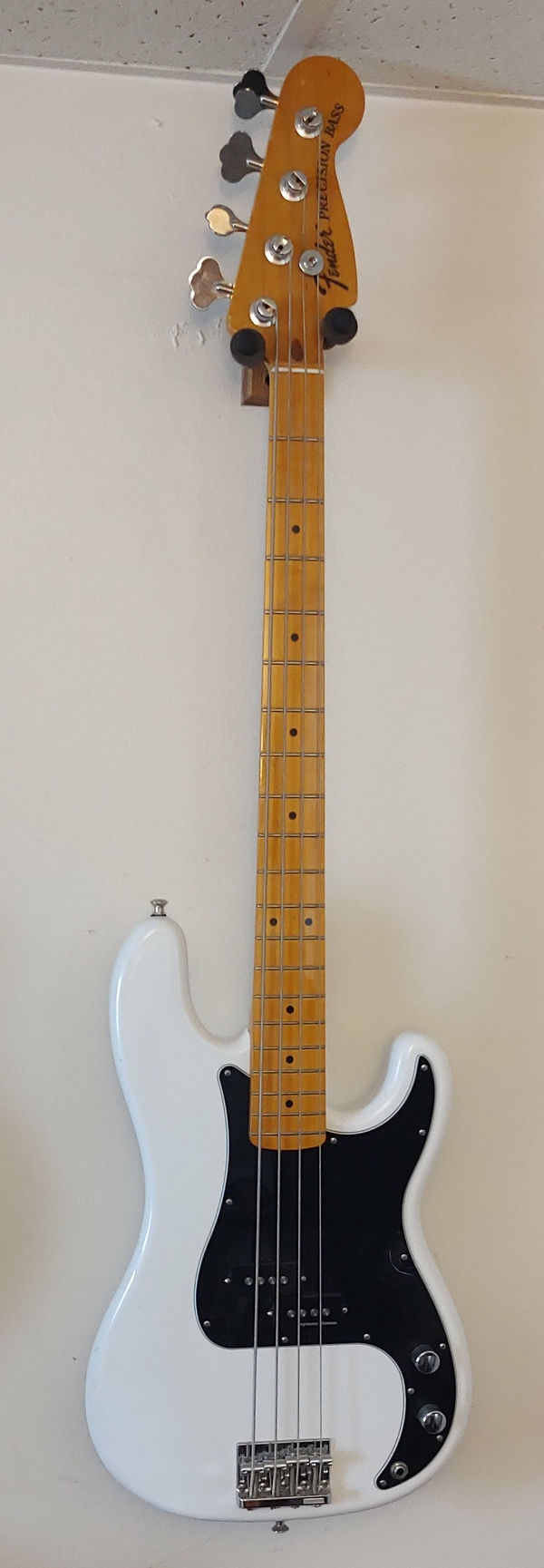
Started during the 2020 pandemic and built over the course of a year, this was used by Chris to track the chordal bass part on "Splendid".
It is constructed from a Warmoth body and Allparts neck, with a Gotoh 601 bridge, Schaller tuners, and a Seymour Duncan Quarter Pounder pickup with CTS and Switchcraft guts, and is a tribute to the bass being smashed on the cover of London Calling. The overall aesthetic is of a mid 70s P-bass, including a 70s style headstock decal and 'F' stamped neck plate, but with the modern upgrades Chris is fond of like a high output pickup and a high mass bridge. The serial number references Chris' birthday (and follows the enumeration style adopted by Fender a few months after he was born).
Leon also used this to track some of the demos for Full Charisma Bypass.
Chris' Bass Pedalboard

Used on 'Splendid", this is a fairly simple layout compared to his guitar board.
Input/output Hub: contains two inputs with an A/B selector and corresponding LED, a tuner assign switch with an LED indicator, a mono/stereo split switch, a micro amp boost circuit to compensate for quieter instruments, an effects loop with 9VDC power tap, and two outputs for stereo operation. All ins and outs are duplicated on a 5 pin XLR.
Boss TU-3S Tuner: run as a sidechain rather than in the signal path.
Arion Bass Distortion: previously employed by Leon on "Snow", this is designed to preserve the low end of a bass and also has a dedicated clean knob to balance the overall sound.
Electro Harmonix Bass Muff: "For that planet destroying whomp" as Chris puts it.
Behringer BEQ700 Bass EQ: usually set for a loud clean boost with a bit of extra top end.
Arion SCH-1 Chorus: this chorus has a very pronounced detune, which creates an almost Doppler like effect when run in stereo. Prominently heard on the chordal bass part of this song.
SansAmp Bass Driver

Used exactly the same way as described on Leon's page.
2021 Ibanez Gio Mikro GSRM20B

Victor Zamudio used this Indonesian built bass to track his Paul inspired part for "This Song's Not About Her". To do this, he set the action slightly higher than normal to "hit it hard with a pick with as little fret buzz as possible". It was plugged into a Apogee Jamx interface, chosen for the built-in compression, and was further tweaked in the mixing process, including running it through a fairly dirty amp simulator to get a fat, vintage, psychedelic sound.