Chris' Gear: The Modern Era
Guitars:
Between the initial breakup and the reunion, Chris continued to play music and amass gear. In that same timespan, his repair and building skills improved as well, so many of the old damaged and retired guitars were brought back into the fold, in addition to the new ones he was acquiring. With the exceptions of the pieces noted to no longer be in existence, the current collection includes all the previously seen models plus these.
2003 Takamine GS330S

Chris’ main acoustic guitar for 20 years, this has a solid cedar top and a satin finish, making for a very rich sound. It also has a Fishman Rare Earth soundhole pickup installed for stage use. Like the Aria twelve-string, this has appeared on nearly every recording Chris has made since he purchased it, and would have been on “Taste” if he had been planning on tracking guitars that day. Given that he wasn’t anticipating that, he used what was at the studio instead.
2017 Epiphone ES335 Pro

This fulfills a childhood dream that began the first time Chris saw Back To The Future. Like Marty's guitar (technically it was Marvin Berry's, but that's nitpicking), this has a Bigsby trem though with a Towner tension bar rather than two studs sticking up awkwardly. It's also a 335 versus a 345, which means that a lot of cosmetic details are different, but ultimately it's a red Gibson style semi hollow with a Bigsby. It's close enough to satisfy the nine year old that lusted after that guitar on the silver screen.
Other mods include replacement knobs and toggle switch cap, and the Dunlop Straploks that adorn all of Chris’ guitars.
2019 Squier Classic Vibe Jazzmaster

This is also something of a "wish fulfillment" instrument. Like the ES335, Chris has long admired and appreciated Jazzmasters, since they are somewhat iconic to the genre of music that The Amoebas are wont to play. And like the 335, he always thought they would look "kinda weird" on him, but ultimately decided that it doesn't matter how it looks if it sounds good.
As it turns out, it looks just fine on him (and it sounds good, too).
This one is mostly stock, with a Roswell bridge pickup and Dunlop Straploks being the only upgrades.
2022 Harley Benton ST-20

While Chris has used Stratocasters many times, both on stage and in the studio, it took thirty five years for him to own one. There is a certain ‘thing’ that a Strat does that no other guitar can really do, and that sound can be a great addition to one’s sonic tool belt.
Like many of Chris' guitars, this has been customized, namely with a variation of the "Gilmour mod"-- a hidden switch allows seven different pickup choices rather than the traditional five, though Chris' version also has a dedicated neck pickup volume control.
And yes, this is an extremely affordable guitar, but a quick glance at many of the other instruments used by the band over the years shows that it’s far from unique in that regard.
Ultimately, this guitar was un-modified and traded in towards other gear.
2023 AstroLux Rawr-ing Bunny

Designed as a sonic replica of Boda, this is a “parts-caster” that Chris built himself. The bulk of it is a Jazzmaster kit with a shorter Jaguar style neck, though with a pair of vintage Silvertone low impedance pickups almost identical to the one in Boda (keen eyed readers may notice that these have black plastic caps while Boda's were white), and the curved tops of these pickups required an extremely curved bridge and a buzz stop bar. The pickguard was custom cut from a blank Jazzmaster guard, and the finish was hand applied with rattle cans.
As for the name, well…
Since it’s replacing a model referencing a celebrity’s childhood imaginary friend, it seemed appropriate to use a childhood character Chris created for this one. Details about that character itself are foggy, but it was apparently a rabbit with a poor attitude. The fact that this is pink and mean seems rather prescient.
Early 2000s Gretsch G1617 Synchromatic Sparkle Jet

Originally employed as the replacement for the Guild on the "Taste" version of “Ultimate”, this guitar has been returned to standard stringing. It sounds especially awesome through the JTM45 clone, which creates a stellar simulation of Malcolm Young’s tone.
It can also be heard on the rare occasion that Chris busts out the Rockabilly licks (because nothing else quite twangs like a Gretsch).
Mods on this include the Bigsby trem and an upgraded wiring harness, plus the ever present Dunlop Straploks.
2024 Squier Paranormal Series Jazzmaster XII


Chris wasn't ever quite happy with his original electric 12-string, a Cozart bought on eBay, and when he saw these blowing up in popularity on YouTube, his interest was piqued.
On a whim, he traveled to his local independent guitar shop to see if they had one, and lo and behold, they did. He strummed a few chords and bought it immediately.
This first Squier (which was a 2023 model) was used extensively on Full Charisma Bypass, but then in 2024 they came out with a Sherwood green metallic model with a matching headstock which happens to be Chris' favorite color scheme. And since he didn't need two, he sold the original white one to his friend Devon.
The only mods are a new set of "chicken head" knobs to replace the original amp style ones, and, of course, Dunlop Straploks.
The first Squier 12 String
2024 AstroLux Hi-Ya Joe

The history of this guitar is a bit odd, but pretty linear. It started life as a Cozart 12 string, but never really played or sounded right, even with the Danelectro style pickup Chris installed in it to resemble those iconic guitars. So, he kept the body, converted it to a baritone with a new neck, and used it on several tracks on Full Charisma Bypass.
The plan was to refinish it in transparent purple, but removing the original finish destroyed a good amount of the decorative veneer since it was perilously thin.
Chris ultimately replaced the body, too, with one factory finished in purple sparkle. To this he added a second lipstick pickup, along with the series wiring Danos are known for, vintage radio style knobs,and the mother of toiletseat pickguard that adorn many of his instruments, and thus turning it from a Frankenstein to a monster.


Previous iterations of this instrument.
That original body, by the way, became….
2024 AstroLux Moxie Boy

No one guitar does everything (if it did, this page wouldn't exist), but this build was designed with versatility in mind.
Named after the mascot of Chris’ favorite soft drink, The Moxie Boy is a hot rodded Esquire, featuring a full power mini humbucker with splitable coils, allowing for both Gibson and Fender style sounds. A dark circuit mimics a neck pickup, and the tone control has been replaced with a kill switch for stutter effects.
The body was salvaged from the Cozart 12 String/Baritone when the decision was made to order an entirely new body for the Bari. Since Chris is a compulsive tinkerer, learning how to do glitter finishes properly was a worthy challenge.
Ca. 2010 Seagull M12 Cedar

As mentioned in its entry, Chris decided to put the Aria 12 string out to pasture after tracking Full Charisma Bypass. While he'd been considering a new 12 string acoustic for some time, it wasn't until he found this that he decided the moment had arrived.
Seagull guitars are well known to working musicians as a winner in the bang for your buck category. Built in Canada from less common but good sounding and easily sustainable woods, they are beloved to many players. Chris used to work for a Seagull dealer, so he had no qualms buying this without trying it first, having never played a bad one.
And this one definitely lives up to the reputation. Possessing a solid cedar top like the Takamine, it sounds good, plays well, and is a welcome addition to the guitarsenal.
2024 AstroLux Corn Bucket
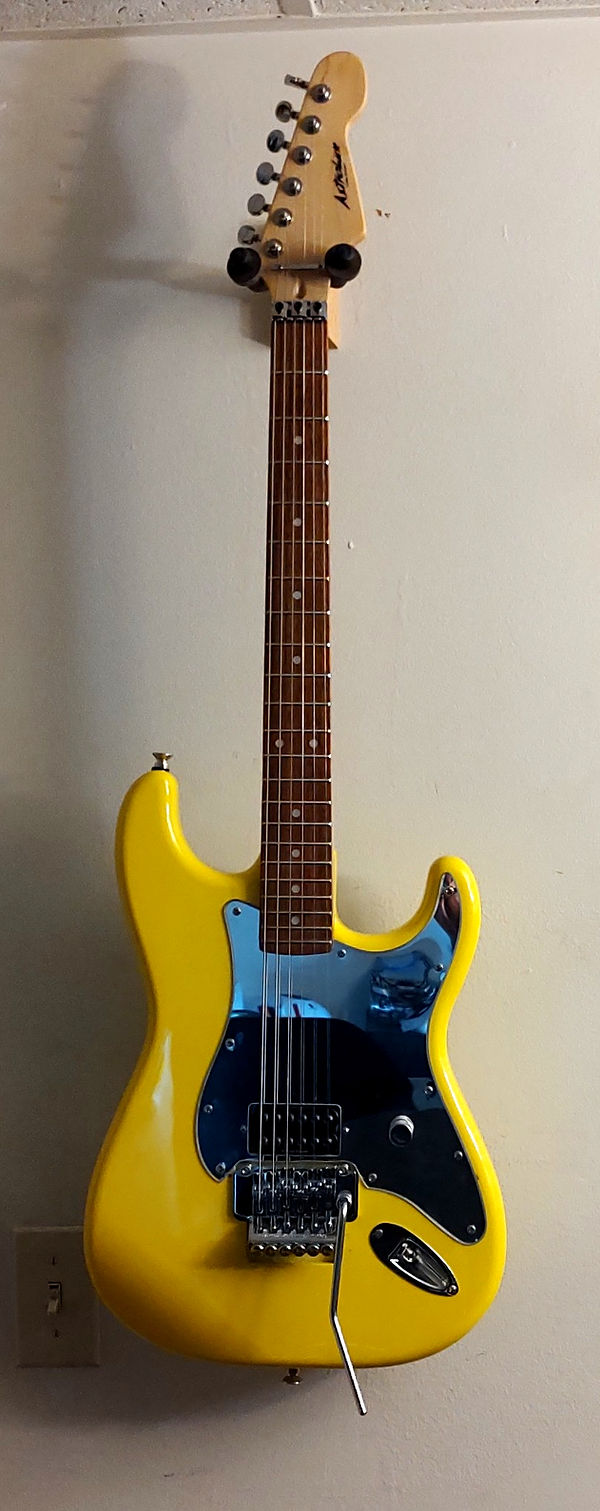
Something of an odd duck versus the rest of his collection, Chris explains:
“I tend to use guitar sounds like a chef uses ingredients or a painter uses colors. Some are not ones that get used a lot, but a little splash of them can bring the creation to the next level. And, perhaps it's because I started playing in the 80s, but an over-wound humbucker in a Fender is such a ubiquitous sound to me that it's surprising that I went without it for so long”.
This one contains a Seymour Duncan Invader with a coil split, and a Floyd Rose because, obviously. And yes, that is a mirror pickguard.
2024 Yamaha LL16

Like many rock guitarists, Chris has mostly focused on his electric playing. But, as evidenced by the proliferation of acoustic guitars on Amoebas records, he's quite fond of the texture they can add to a song.
One thing that has always been missing, though, was a really high quality acoustic, made with solid tonewoods rather than laminates.
This was strictly due to budget.
However, after much research, this was purchased with the intent of filling that hole. A fully solid acoustic guitar, with rosewood back and sides like some iconic Martins (though for a fraction of the price tag), this is destined to become as good a friend as the Takamine, and compliments it beautifully in a mix.
2025 Parts-caster Stratocaster
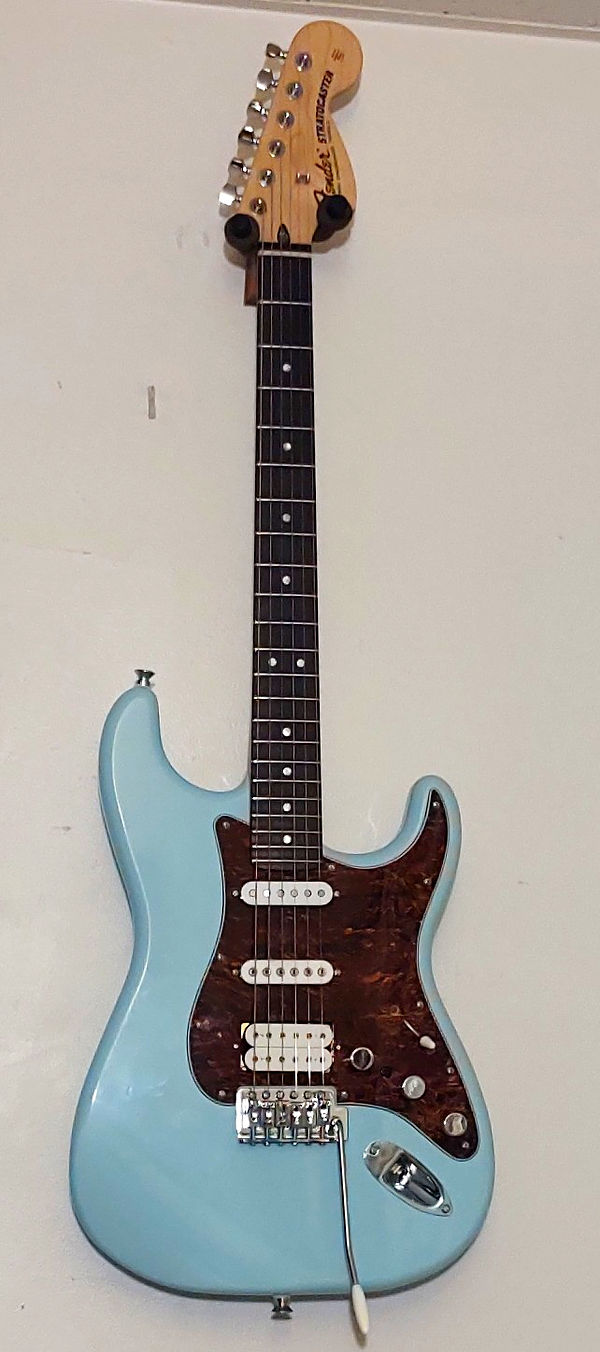
While the Harley Benton was a good way to dip one’s toe in the Stratocaster pond, it eventually became clear that something better was desired. With that in mind, Chris assembled this from a Squier body and hardware, a Mighty Mite neck with an aftermarket decal, and two different pickguards: one has the stock Squier pickups and electronics, but the other is loaded with a Dimarzio Super Distortion in the bridge (with a coil split), a G&L S500 in the middle as a tribute to Marissa Paternoster, and a Fender Tex-Mex pickup in the neck. The “Gilmour Mod” exists on both versions, along with a solderless disconnect so exchanging them only requires a screwdriver.
With the Squier components installed.
2018 Danelectro Stock ‘59 DC

Given his constant quest for different tones, plus his use of borrowed Danos in the past, it was inevitable that Chris would eventually get one of his own. This one started life as a fairly pedestrian black version, but after a refinish is now a blue sparkle model. The other mods include a Bigsby style trem, six-position rotary pickup selector, and, of course, Dunlop Straploks. Not pictured here but available when needed is a Gotoh "Buzz Bridge" that converts this to an Electric Sitar.
2026 Squier FSR Classic Vibe 60’s Competition Mustang

Jamie isn’t the only person who has been in this band with a fondness for Nirvana.
Like the 335 and the Jazzmaster, Chris had long admired the guitar from the “Smells Like Teen Spirit” video, as had many people given its iconic status as "the guitar that killed hair metal". While other versions had been released over the years for much less than the original, they were still out of his budget. But, in fall of 2025, this version was announced as a pre-order, and he quickly snapped one up, having it ultimately land on his doorstep on his 50th birthday. Despite the fact that the original version has some well known mods, Chris left this one stock other than the omnipresent Dunlop Straploks.
2024 Epiphone Les Paul Junior

Since his discovery of the awesomeness that is a P90 through a Marshall, that sound has become one of the fundamental tones Chris uses to build his soundscapes.For many years, he’s relied on the Hondo “Lawsuit” Les Paul for that, but that guitar is painfully heavy, so a lighter alternative was chosen and the Hondo got different pickups installed.
The only mods are a replacement pickguard and knobs, and, of course, Dunlop Straploks.
2025 Gretsch Jim Dandy Parlor

Bought on impulse during a sale at his local independent guitar shop, a parlor guitar had long been on Chris’ checklist of possible recording tools. This one was at exactly the price point he was looking for, so despite its fairly basic nature with a plywood body and a satin finish, it fits the niche it was designed to fill. In a rare occurrence, this has been left completely unmodified.
Amps:
Marshall 3210 100 Watt MOSFET Head w/Marshall 1960A Speaker Cab
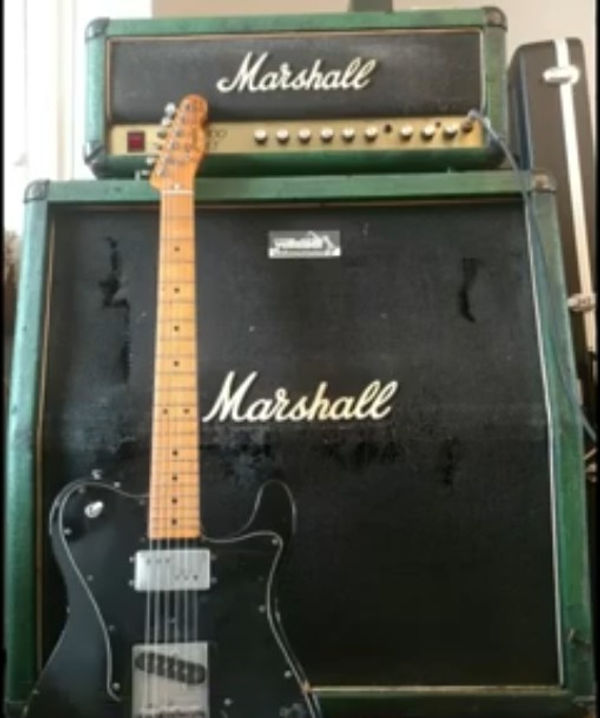
Though not the original head from the Boston Era, this is another example of the same model. That first one met a rather ignominious fate when it fell out of the equipment trailer of Chris' band at the time and was run over by a truck. After picking up the shattered bits, gluing the timber parts back together, and trying in vain to rebuild the circuit, he ultimately bought a replacement from a customer at his music store job and installed its guts into the original enclosure. This one is also paired with a proper speaker cabinet rather than the "two combos as cabs" rig, and despite buying that cab in 1997, it wasn't used on stage with The Amoebas until the 25th anniversary reunion show. It also clearly shows evidence of Chris owning cats.
Hand Built JTM45 Clone w/THD Hot Plate

This amp has a sad story. Chris used to play in a band with its previous owner, Adam, and maintained a friendship with him long after that band broke up.
When Adam died young, his girlfriend asked Chris to help find a buyer for it, which he tried to do. After a year of no success, she offered to give it to him outright, which he accepted immediately.
After a quick setup by a tube tech, it was used on the "Bells!" EP by both groups.
The Hot Plate allows for the amp to be cranked up to yield real power tube distortion without being deafeningly loud.
While being a great sounding amp, it is undeniable that the circumstances that brought it to Chris' possession are quite somber.
Blackstar HT5R

A small, affordable, all tube 5 watt combo that allows the classic trifecta of tones: Fender clean, Vox Clean, and Marshall dirty (it also does a passable Mesa dirty, but is a bit weaker in that department). Hated by many for its lack of serviceable parts, it's perfectly fine for a home practice and recording rig, which is what it's used for.
Effects:
"Taste" Pedalboard

This board was ultimately disassembled, with some pedals being dedicated to other boards and others set aside for use as needed.
A/B Switch
Similar to the one on the Boston board, and serving the same function.
Sabine STX1100
A chromatic tuner with an assign switch built into a cat food can.
Marshall Guv’Nor
One of, if not the first, “amp in a box” pedals, this is a newer version and makes anything it’s plugged into sound like a Marshall.
Electro Harmonix Big Muff Pi 7C
As described in the Boston board section.
Maestro PS1-A Phase Shifter
As described in the Narcissism Era section.
DOD FX65 Chorus
As described in the Boston board section.
DOD 680 Analog Delay
Acquired from Devon Irish of the band Roma, this was eventually sold during a financially lean time. Fun fact: all of the current members of The Amoebas played in Roma at different times.
Current Pedalboard:

This is now Chris' main board, though occasionally pedals get added or exchanged. However, this configuration remains as Chris' default layout.
Master Control Hub
Contains an A/B to select two inputs, tuner assign, and a two button footswitch for the amp.
Boss TU-3S
A compact chromatic tuner.
FuzzCAN Cosmic Splat
A clone of the foxx Tone Machine octave fuzz, which was a prototype for Chris’ pedal company that never quite took off. Usually used in straight fuzz mode, but occasionally that upper octave gets turned on for some extra screech.
Wampler Ego V1
Compression is a curious effect- it makes clean notes sustain longer, and punchy notes punchier, plus one can really squash the signal to get the “Big Star tone”. Chris uses this to recreate his vintage clean sound which was heavily compressed by the Marshall 30 Watt combo.
This is also mandatory for the 12 string; it just does not jangle the same without some compression.
Electro Harmonix Micro POG
This is not used often, but it's a practical effect to have around. It generates a signal an octave below and a signal an octave above the original and allows them to be blended in accordingly.
ProCo Fat Rat
After some time experimenting with different hard-clipping distortion pedals, including a few home made ones, Chris ultimately went with a ProCo Rat. Since other members of the band had a history of using Rats, it was a logical choice. After extensive use of one on Deluxe Tree Stand, it took a permanent place on Chris' board, and was eventually upgraded to this model.
Way Huge Swollen Pickle MkII
A modded version of the absolutely crucial green Russian Big Muff, this allows for a nearly identical tone with a bit more tweakability. Scarily, it's even louder than the original, and the Big Muff is known for its intense volume, so that's a win. It's even the right color!
Heptode Virtuoso Phase Shifter- As mentioned elsewhere, Chris' vintage Maestro PS-1A formed a huge part of his sound, but is too valuable and delicate for routine use. However, there is a boutique company in France making the only pedal to perfectly copy that all important Maestro, albeit updated for modern pedalboards (and about a quarter of the size and price of the original).
TC Electronics Corona Chorus
To a '90s guitar player, the right chorus is almost as important as the right distortion, and like the Flashback (see below), this offers lots of options with minimal effort.
MXR M159 Stereo Tremolo
A fairly standard tremolo circuit, though with stereo outputs available. Despite this, it's run in mono in this configuration.
TC Electronics Flashback II Delay
An extremely versatile digital delay, it also includes simulators for analog and tape styles, as well as reverse delay and even looping, plus many stereo effects and the ability to program and customize via computer software.
JHS 3 Series Octave Reverb
Sometimes, the reverb in the amp just isn't enough. Also, this does "shimmer" 'verb, which sounds bloody gorgeous.
The Make It Louder-er
As can be seen from the "Solo In A Box" entry, an over the top boost has been a goal for decades. While it took a while to become evident, a standard boost pedal placed at the right place in the circuit can be remarkably effective (it's in the effects loop, if you're curious). This is a clone of the MXR Micro Amp, though in s a smaller package than the original.
Voodoo Labs MONDO Power Supply
All the pedals and lights get juice from this behemoth of a power supply.
Pimp Lights
Multi color LEDs underneath the board make it sexy.
The Boston Board Sonic Replica

This is a "sonic replica" of Chris' second pedalboard, rather than an exact recreation of it. Some of the pedals have been swapped out for others for at least one if not all three of the following reasons:
-
An exact duplicate of the original pedal would be cost prohibitive
-
The original pedal is still in Chris' collection but is already in use on the Narcissism board, or is far too personally valuable to be used regularly (and possibly damaged)
-
The original pedal is bulky/delicate and a smaller/more durable option is used.
In all cases, the newer versions share the circuit topology of the originals, and sound identical.
Other modern upgrades include the Pedaltrain board and a Truetone CS12 power supply (the original had individual wall warts for each pedal).
A/B Switch- selects between two inputs which are hidden under the phase shifter.
Matrix SR-3000 Tuner- while the vintage board didn't have a tuner permanently mounted to it, Chris did briefly own one of these before it disappeared after a gig (whether it was forgotten or stolen is unknown). Since this unit was modded by a previous owner to not mute the signal, it uses an external bypass switch like Chris' other boards.
FuzzCAN Pink Elephant- a simple, two-transistor Fuzz Face clone. This one has the addition of a "drunk" mode, which alters the circuit to get the "Spirit In The Sky" tone, but that option is rarely used.
DOD 555 Distortion- this, like all of the DOD pedals on this board, is a duplicate of the original. See the description in the Narcissism board section.
FuzzCAN Zelenyy- a clone of the mandatory green Russian Big Muff, right down to some NOS Soviet transistors as used in the original.
Maestro Orbit Phaser- this is effectively the PS1-A, adapted to modern standards. As the Swollen Pickle is to the Big Muff, this has everything great about the original pedal, but with more adjustability.
DOD FX65 Chorus- see description in the Boston board section.
DOD FX75B Stereo Flanger- see description in the Boston board section.
DOD FX22 VibroThang- another pedal that wasn't mounted on the original version, but frequently added via the board's effects loop, and prominently heard on More.
Dunlop Crybaby Mini Wah- a smaller version of the one described in the Narcissism board section.
DOD DFX9 Digital Delay- see description in the Boston board section.
JFET Boost (hidden)- one of the quirks of Chris’ Boston era rig was his Marshall head which could be used with both the clean and dirty channels running simultaneously; a feature he exploited. As with the combo before, he set it just to the edge of breakup, which added a distinct sound to his unaffected tone.
Since most other amps don't do this, a small boost circuit with a similar design to the front end of that amp was hidden in the output section of this board to simulate his sound from that era.
Travel Board

This was designed as a "bare necessities" version of the main pedalboard. When combined with the Astrolux Moxie Boy Chris has nearly all of his default sounds available, to the point that this board and that guitar usually live at Aaron's house so he doesn't need to bring a bunch of gear to record tracks there.
Rowin LT-910 300 Chromatic Tuner- a compact and affordable tuner.
Scabby- a Rat style distortion, built from a kit (including an LM308 op-amp for all the "magic chipset" believers), this was purchased assembled with no information of who manufactured it. Chris added labels to reference a song from Shellac's final album.
Electro Harmonix Green Russian Big Muff Pi Nano- you didn't think this would get skipped, did you?
Behringer VP1- a clone of the Electro Harmonix Small Stone. It costs less than the real thing and sounds better than most other affordable phasers.
Boss CE-5 Chorus- the Boss CE series is the Kellogg's Corn Flakes of chorus pedals, being the original, and according to many, the best. Since the specific chorus pedals that Chris prefers are getting rarer and more expensive with each passing year, this was chosen due to its easy replaceability.
TC Electronics The Prophet Digital Delay- A simple, affordable delay with clean repeats and long echo times when needed.
Boss IR-2 Amp & Cabinet Simulator- this is the not-so-secret weapon of this board. By using it, Chris doesn't need to rely on an amp, and can get his desired tone while plugged directly into a recording interface.
Narcissism Board "De-Crapified"

Another reproduction of Chris’ first board, this one is designed to remove the shortcomings inherent in the original, mostly modifying some circuits to remove the tendency to suck the tone out, and placing the pedals in an order that is in line with modern ideas of “correct “ pedal layout.
A/B Switch- Recycled from the "Taste" board, and updated with the green and blue color-change LED that adorns several of his other boards.
Korg Pitchblack Mini Tuner- A chromatic tuner with a small footprint. Not present on the original board, but if pedal tuners had been readily available and affordable in 1993, he would have used one.
MXR DynaComp- The Aria APE-1 contained four analog effects, all of which were based on other circuit designs. The compressor in this unit was clearly cloned from the MXR layout, so despite the fact that it was all but unused back then, it is represented here in updated form.
Crybaby CBG95 Wah- Modded to have the Stinkfoot true bypass, plus a Q control and a hotter front end, this lived at the end of the chain originally. Chris erroneously figured that since a tone control was the final stage in the guitar that a tone based pedal should also be last.
FuzzCAN Hot Garbage- The DOD 555 Performer Distortion was the sound of classic Amoebas records but is, at its core, pretty badly designed. Several features make it undesirable to a modern player, so this keeps the heart of the circuit intact but removes the nasty bits.
FuzzCAN Ultra Kyle (Snow Leopard Edition)- As with the DynaComp, the Aria contained a clone of the Distortion+ circuit. This is Chris’ take on the same pedal, with the addition of a Rat style tone control and selectable diodes.
Electro Harmonix Bad Stone Phase Shifter- The most distinct thing about the Maestro PS-1A is that it's a six stage phaser (most of the more common/popular ones are four), which gives it a certain character that's tough to find in an affordable, compact format.
Unless you own one of these.
Series 10 Chorus- The hardest effect to find as a standalone unit is the distinct “seasick” chorus from the APE-1. Aria did release all of the circuits in that unit as individual pedals, and a few made it to the market as budget friendly versions under their Series 10 brand which was also seen adorning the headstocks of many a pointy guitar at discount stores in the 80s.
Behringer VD400 Vintage Delay- The final circuit cloned in the APE-1 was the Boss DM-2 analog delay. It was such a popular pedal that pretty much every bucket brigade echo in existence is a direct copy of it, and this is no exception.
Voodoo Labs Pedal Power 2 Plus- The industry standard power supply which, like the tuner, was not available during the original board's construction.
Other Gear:
In addition to being a gear junkie, Chris has always been a tinkerer in the studio. His desire to create dense soundscapes led to him using many instruments, amps, and pedals that were not part of his live rig, and oftentimes were the property of the studio itself. In fact, it's his detailed notes about The Amoebas recordings that provided the bulk of the information for this page. Click here for a list of all of his additional equipment.
Strings and Picks:
DR Tite Fit 10-46 electric, DR Sunbeam 12-54 six string acoustic, DR Rare 10-48 12 string acoustic, Ernie Ball Slinky 12 string electric, single strings (two 10s, two 26s, and two 46s) of whatever brand the store carries for "Ultimate"
Dunlop Tortex .73mm standard


